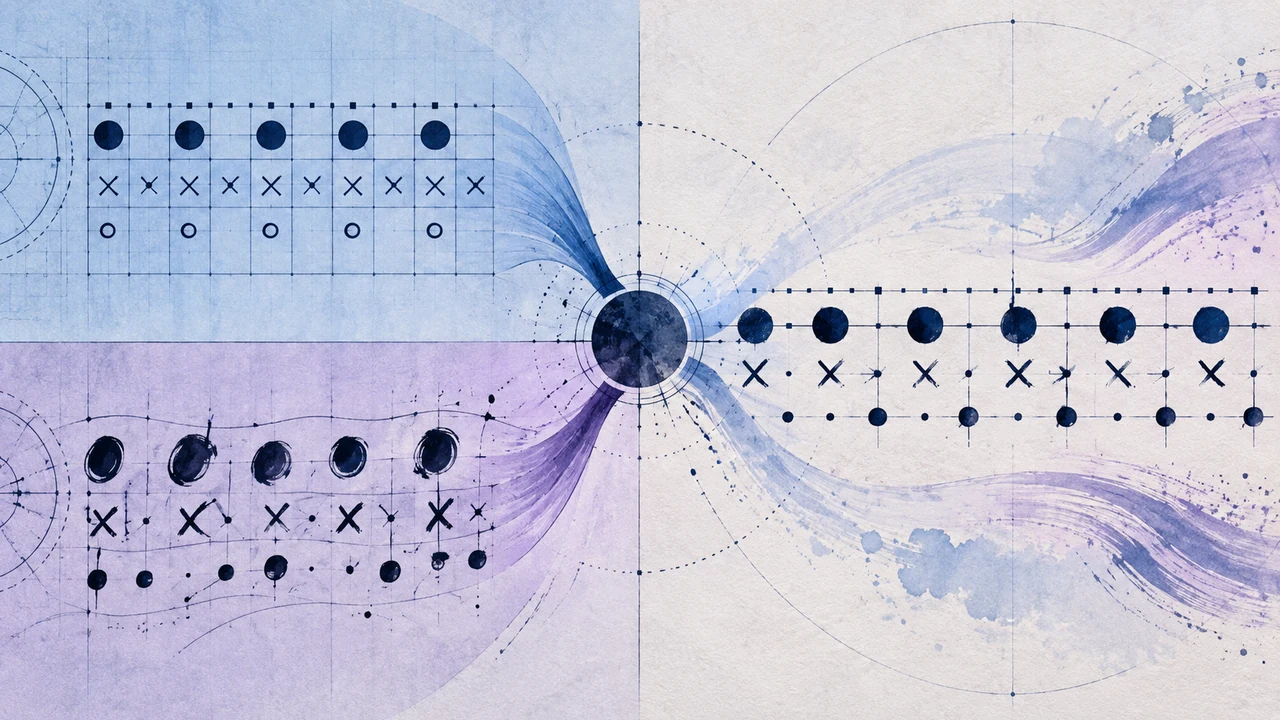
Four-bar variation works when the listener recognizes one groove and notices small signs of direction. Keep most structural hits stable, then use subtraction, a pickup or a short fill to distinguish the phrase ending.
Changing every bar equally makes the loop harder to learn. A common useful shape is statement, repetition, slight change, stronger turnaround.
The short answer
Four-bar variation works when the listener recognizes one groove and notices small signs of direction. Keep most structural hits stable, then use subtraction, a pickup or a short fill to distinguish the phrase ending.
Changing every bar equally makes the loop harder to learn. A common useful shape is statement, repetition, slight change, stronger turnaround.
What matters before you start
Repetition establishes identity
The first two bars should give the listener enough information to understand the groove.
Variation needs a hierarchy
A changed hat is smaller than a missing kick or a full snare fill.
Phrase endings deserve the strongest change
Save the most noticeable variation for the bar that leads onward.
A practical workflow
- 1. Write one strong bar
Make the core pattern work without any fill.
- 2. Duplicate it four times
Start from consistency rather than writing four unrelated bars.
- 3. Keep bar two stable
Use exact repetition or one quiet detail.
- 4. Change one element in bar three
A removed kick or percussion answer can create anticipation.
- 5. Write a short bar-four turnaround
Add or subtract activity just before the next phrase.
- 6. Test the loop boundary
The final event should lead naturally back to bar one or into the next section.
Common problems and how to fix them
Adding new sounds in every bar
The palette grows faster than the phrase.
Making bar four permanently busy
A constant fill loses impact during long sections.
Forgetting the melody phrase
Drum variation should respond to musical changes, not only bar numbers.
A focused practice exercise
Limit the entire four-bar phrase to two changed kicks, one hat rest and one final fill. If the variation is still obvious, the pattern has enough contrast.
How to make the decisions in context
How to Create Four-Bar Drum Variation Without Losing the Groove is easier to apply when every move answers a musical problem. Before changing anything, play the relevant section from a few bars before the change to a few bars after it. That longer window reveals whether the result supports the phrase, transition and energy of the track. A choice that sounds impressive in a short solo loop can still weaken the full arrangement. Keep the level matched as closely as practical so a louder version does not win by default.
Start with repetition establishes identity. The first two bars should give the listener enough information to understand the groove. Treat that as the control condition for the session. Make one clear change, replay the same passage and write down what improved: timing, separation, impact, movement or speed of use. If the benefit cannot be named or heard consistently, return to the simpler version. This keeps the workflow connected to the primary goal: extend a one-bar groove into a four-bar phrase with controlled changes.
Next, check variation needs a hierarchy. A changed hat is smaller than a missing kick or a full snare fill. Listen once at the normal working level, once quietly and once with the whole beat playing. Quiet playback is useful for judging hierarchy because the strongest rhythmic roles remain obvious while decorative details recede. Full-context playback shows whether the technique competes with bass, melody, vocals or effects.
Finally, use phrase endings deserve the strongest change as the restraint test. Save the most noticeable variation for the bar that leads onward. Duplicate the pattern, channel or project state before a larger edit so the original remains available for comparison. The point is not to avoid experimentation; it is to make experiments reversible and easy to judge. Commit only when the edited version works in more than one listening context.
This decision process also makes collaboration clearer. Instead of saying a version is simply “better,” describe the function of the change: the backbeat reads sooner, the low end leaves more headroom, the fill announces the next section, or the library is faster to navigate. Functional language helps another producer understand the intention and reproduce the result without copying arbitrary settings.
A second-pass review that catches weak choices
After completing the first workflow, take a short break and begin the review from write one strong bar. Make the core pattern work without any fill. Do not immediately edit while the track is playing. First identify the exact moment where the result stops supporting the music, then make the smallest change that addresses that moment. This prevents a local problem from turning into an unnecessary redesign of the whole pattern or setup.
At the middle of the process, revisit change one element in bar three. A removed kick or percussion answer can create anticipation. Compare the section before and after that step at the same start point. If the technique improves one element but creates a new conflict elsewhere, solve the conflict at its source rather than stacking corrective processing. Fewer deliberate moves are easier to recall, automate and revise later.
The final review should include test the loop boundary. The final event should lead naturally back to bar one or into the next section. Then test the result in at least two arrangement sections. A loop can hide repetition, tail overlap and transitions that only become obvious across a complete phrase. If the article's workflow is organizational rather than sonic, close and reopen the project or preset and confirm that files, names and routing still resolve as expected.
Watch specifically for “Adding new sounds in every bar.” The palette grows faster than the phrase. Also check for “Making bar four permanently busy.” A constant fill loses impact during long sections. These are useful failure tests because they focus attention on behavior, not on a screenshot or a fixed plug-in value. If either problem appears, step back to the last version that worked and change one variable at a time.
Save the successful version with a useful name and enough context to understand it later. For a pattern, that can mean tempo and section role; for a rack or template, it can mean instrument purpose and version; for an export, it can mean song, stem role and revision. Clear versioning is part of production technique because it lets you experiment without losing a reliable result.
Session checklist
Use this short order when practicing four bar drum pattern variation. It is a reminder, not a rule: skip a checkpoint only when the track gives you a clear reason.
- Write one strong bar
- Duplicate it four times
- Keep bar two stable
- Change one element in bar three
- Write a short bar-four turnaround
- Test the loop boundary
Finish by bypassing or comparing the complete change, not just its final component. Confirm that the result still serves the original intent, survives a quiet playback pass and remains understandable when the project is reopened. If it does, stop editing and move to the next musical decision.
Useful next reads
Keep the next session focused with these related DRUMKITS.SHOP guides and resources:
Frequently Asked Questions
Does every four bars need a fill?
No. Repetition can be powerful, and some sections need longer stable phrases.
Should variation use new samples?
Usually timing, velocity and subtraction are enough. New samples are optional color.
Can bar two change?
Yes, but preserve enough repetition for the phrase to remain recognizable.
How do I stop a loop sounding repetitive?
Vary arrangement layers as well as drums; not every change must occur inside the pattern.
Conclusion
Think in phrase roles: establish, repeat, develop and turn around. Small changes become meaningful when most of the groove stays stable.